EU Machinery Regulation 2027: Technical Document Storage
- Friday, October 23, 2026

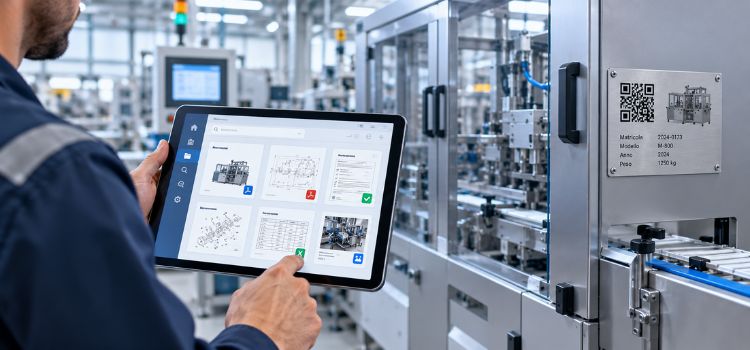
From 20 January 2027, Regulation (EU) 2023/1230 on machinery will apply, replacing Machinery Directive 2006/42/EC. For industrial machinery manufacturers, this is a timely opportunity to review how technical records are prepared, retained and made available for each machine.
Technical document storage under the 2027 EU Machinery Regulation involves two distinct needs: meeting legal requirements for keeping conformity documentation and managing the manuals, declarations, diagrams and service information provided to customers.
One important distinction: the Regulation does not generally require every technical file to be kept exclusively in digital form. It establishes specific documentation and retention obligations, while allowing digital instructions for use under defined conditions. A well-organized document management system can support both needs.
EU Machinery Regulation 2027: what changes for document storage?
Article 10 of Regulation (EU) 2023/1230 requires manufacturers to draw up the technical documentation described in Annex IV before placing machinery on the market or putting it into service. Technical documentation and the EU declaration of conformity must also be kept at the disposal of market surveillance authorities for at least 10 years.
However, not all machine documents serve the same purpose. Manufacturers need to distinguish between the technical documentation used to demonstrate conformity and the information made available to users, such as instructions for use and the EU declaration of conformity.
For companies producing customized equipment or multiple units of the same model, this separation is especially useful. Each document should be linked to the correct machine and configuration.
Which documents should industrial machinery manufacturers retain?
Technical documentation demonstrating conformity
Annex IV, Part A, sets out what technical documentation must contain. Depending on the machinery and the relevant requirements, this includes:
- a description of the machinery, its characteristics and intended use;
- risk assessment records and the protective measures adopted;
- drawings, design diagrams and information needed to understand how the machine works;
- references to the applicable harmonised standards and other technical specifications;
- relevant test results, calculations and verification records supporting conformity assessment.
The complete technical documentation does not have to be made publicly available to customers. The manufacturer must instead keep it available to the competent authorities in accordance with the applicable legal obligations.
Manuals, declarations and customer-facing documents
Alongside the regulatory technical documentation, manufacturers can benefit from a separate, accessible collection of the documents supplied with their machinery and used in after-sales support:
- instructions for use and maintenance manuals;
- the EU declaration of conformity, or the access details permitted by the Regulation;
- electrical and pneumatic diagrams and other shareable technical information;
- spare parts lists, drawings and support documentation;
- relevant photographs, videos and technical updates.
Not every item in this list is mandatory for every machine. Nevertheless, centralizing useful customer documentation makes information easier to retrieve and helps reduce repetitive requests to technical support teams.
How long must machine documentation be retained?
The Regulation distinguishes between retaining records for the authorities and keeping digital information available online:
- Technical documentation and the EU declaration of conformity: these must remain at the disposal of market surveillance authorities for at least 10 years after the machinery has been placed on the market or put into service (Article 10(3)).
- Digital instructions for use: these must remain accessible online throughout the machinery's expected lifetime and for at least 10 years after it has been placed on the market (Article 10(7)).
- Digital EU declarations of conformity: these must remain accessible online throughout the machinery's expected lifetime and, in any event, for at least 10 years after placing on the market or putting into service (Article 10(8)).
Specific provisions also apply to partly completed machinery, including technical documentation, assembly instructions and the EU declaration of incorporation.
In practice, this means that document management should be designed for long-term use. Beyond uploading files, manufacturers should define responsibilities, backup arrangements, update procedures and ways to ensure documents remain retrievable.
Why organize machinery documentation by serial number?
Keeping every PDF in a shared folder may seem straightforward. Problems arise when the same machine model is sold with different accessories, components or configurations.
A generic manual may not accurately describe the machine installed at a customer's site. Similarly, an outdated diagram could be mistaken for the correct version.
Serial-number-based document management allows manufacturers to link manuals, diagrams, declarations and after-sales information to each individual machine. This helps them:
- identify the documents relevant to a specific unit;
- reduce mistakes caused by different versions or configurations;
- make updates easier to distribute to customers;
- find technical information more quickly during support activities.
For more practical guidance, read our article on managing machinery documentation by serial number.
Digital manuals and QR codes: what does the 2027 Machinery Regulation allow?
Under Article 10(7), manufacturers may provide instructions for use in digital format, provided that certain conditions are met. In particular, they must:
- indicate on the machinery or, where this is not possible, on its packaging or an accompanying document how to access the digital instructions;
- provide the instructions in a format that users can print, download and save on an electronic device, so they remain accessible even during a machine breakdown;
- make the instructions accessible online throughout the expected lifetime of the machinery and for at least 10 years after placing it on the market.
If requested by the user at the time of purchase, the manufacturer must supply paper instructions free of charge within one month. In addition, essential safety information must be supplied on paper for machinery intended for non-professional users or reasonably likely to be used by them.
A QR code attached to the machine can provide a convenient route to digital documents. However, a QR code alone does not demonstrate compliance. The content of the instructions, the ability to keep an offline copy and continued online availability also matter.
Find out more in Digital Machinery Manuals: Can Paper Be Eliminated from 2027?
How to prepare your machine document archive for 2027
These six practical steps can help manufacturers build a more structured approach:
- Inventory your machine serial numbers. Link every machine to its model, customer and configuration.
- Review available documents. Identify manuals, declarations, diagrams and any missing or duplicate files.
- Separate document collections. Keep confidential technical documentation distinct from information intended for users.
- Link files to individual machines. Avoid relying solely on folders organized by model name.
- Manage versions and access rights. Identify current files and decide who may view them.
- Plan for long-term availability. Define retention, backup and digital-link checking procedures.
Effective document organization is valuable beyond regulatory preparation. It also improves technical workflows and the quality of after-sales support.
TecnoScan: machine technical documentation organized by serial number
TecnoScan is designed for industrial machinery manufacturers that want to store, organize and share technical documentation for machines supplied to their customers.
Through a centralized digital archive, you can link manuals, diagrams, certificates, spare parts lists, photographs and videos to each serial number. Customers can access the documents shared with them by searching for a serial number or scanning a QR code.
Practical benefits for machinery manufacturers
- Faster document retrieval: files are associated with the machine they describe.
- Controlled sharing: choose which information your customers can view.
- Easier updates: make updated versions available without repeated manual email exchanges.
- More efficient after-sales support: customers can find available technical information independently.
Explore how TecnoScan works and learn how to simplify your machinery documentation processes.
An important clarification: TecnoScan supports document organization and sharing. It does not replace the manufacturer's legal responsibilities for conformity assessment, preparing technical documentation or retaining it under the applicable rules.
Prepare for the 2027 Machinery Regulation with better document management
Managing machinery documentation is about more than keeping files. Manufacturers need to retrieve the right records, associate them with the correct equipment and make appropriate information available to authorized users.
TecnoScan helps organize manuals, diagrams, certificates and after-sales documents, making it easier for customers to access technical information about their machines.
Would you like to organize your machinery's technical documentation and streamline after-sales support?
Fill in the form below, we’ll call you shortly !